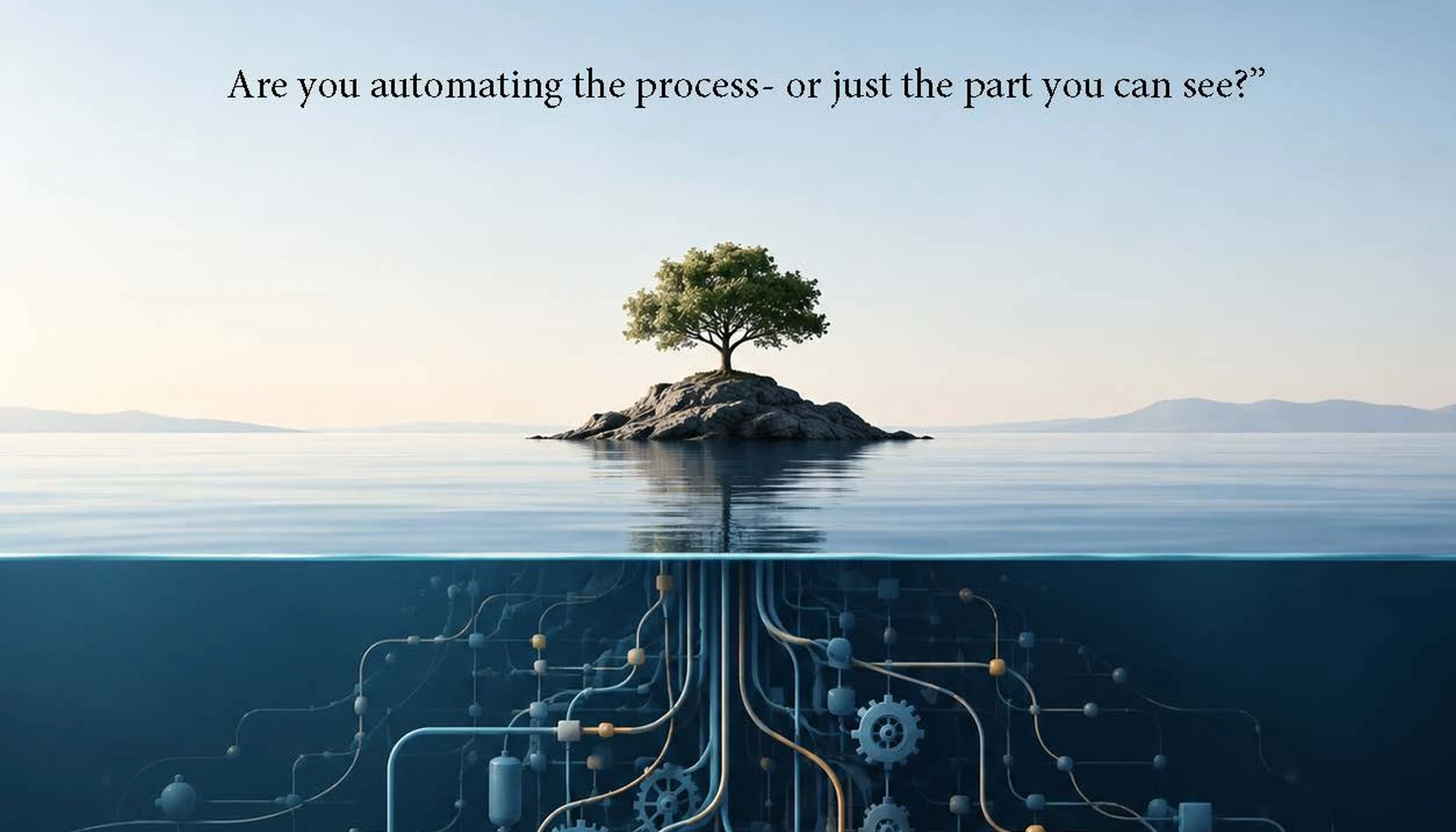
AI can automate work faster than many companies can explain how that work actually gets done.
September 17, 2026
The biggest obstacle to getting real value from AI may not be the technology. It may be how well a company understands how its own work and decisions actually happen.
Before asking what AI can automate, leadership should ask: Do we understand our business well enough to automate it?
For CEOs, COOs, and other leaders sponsoring significant AI initiatives, this may be one of the most important readiness questions.
AI operates on the processes, decisions, information, and rules we give it. But organizations rarely operate exactly as their procedures, organization charts, or system documentation suggest.
Approvals evolve. Exceptions become routine. Experienced people develop workarounds. Decision authority becomes informal. The written process and the actual process gradually separate.
That may be manageable when people are involved at every step.
It becomes more consequential when AI begins making or executing decisions.
Before committing heavily to AI, leadership should have a clear picture of how work and decisions actually happen:
- Who really makes which decisions?
- Where are the important handoffs?
- Which exceptions require judgment?
- Where do people routinely work around the established process?
- Which assumptions exist only because “that’s how we’ve always done it”?
These are not primarily technology questions.
They are operating-model questions.
AI can improve a well-understood operation.
But where responsibilities, rules, or decision rights are unclear, it can also turn organizational ambiguity into automated behavior.
The companies that understand that distinction may not move more slowly.
They may simply know what they are accelerating.